


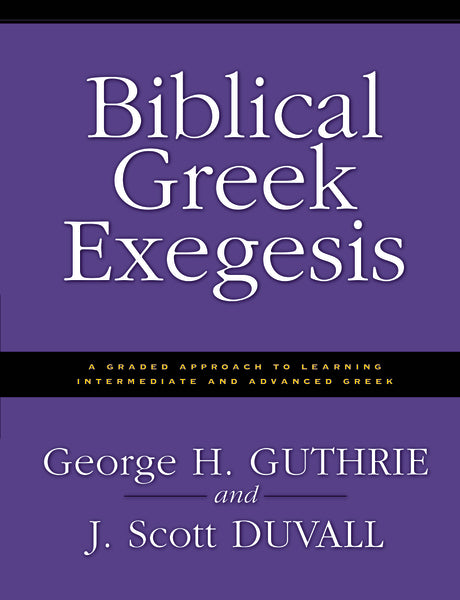
Biblical Greek Exegesis
A Graded Approach to Learning Intermediate and Advanced Greek
Biblical Greek Exegesis presents a proven, highly practical approach to the study of intermediate and advanced Greek grammar. Most textbooks focus on learning syntactical categories, illustrated by sentences taken from the Greek New Testament, and place little emphasis on how to apply Greek grammar to the Greek text in preparing sermons and lectures. In contrast, Biblical Greek Exegesis stresses “real-life” application. Beginning with selections from the Greek New Testament, students learn intermediate and advanced Greek grammar inductively by analyzing the text. The process closely resembles the approach used in sermon and lecture preparation. In Part 1 (SYNTAX), students work through nine selections from the New Testament, taken from the Gospels, Paul’s letters (including Romans), and the General Letters. The selections are arranged in order of increasing difficulty. The student becomes familiar with syntactical categories through translation, grammatical analysis, and grammatical diagramming, supplemented by class discussion. Equally important, the length of these selections allows for semantic diagramming and analysis. This provides a tool for analyzing larger units of meaning, which is not possible when working only with sentences that illustrate specific points of grammar. In Part 2 (EXEGESIS), the student takes the sections from the Greek New Testament through a twelve-step method of exegesis and exposition. The student works through one section of approximately fifteen verses every two weeks, beginning with the first step—spiritual preparation—and ending with application and a preaching/teaching outline. This approach has two benefits. Advanced Greek students learn to use the Greek text and grammar as they will in the “real world.” They also learn to integrate other significant areas such as literary form and textual criticism, as well as the use of exegetical tools. In short, they become better expositors of the Word of God. Bibliographies are provided for each of the twelve steps in the exegetical process. Also included is a summary of syntactical categories based on Wallace’s Greek Grammar Beyond the Basics. This successfully field-tested approach to intermediate and advanced Greek will help students bridge the gap between understanding the categories of Greek grammar and the demand to communicate the meaning and significance of the New Testament message to the twenty-first century.
Additional Information
- Contributor(s): George H. Guthrie, J. Scott Duvall
- About the Contributor(s):
George H. Guthrie (PhD, Southwestern Baptist Theological Seminary) serves as Professor of New Testament at Regent College in Vancouver, Canada. He is the author of numerous articles and over a dozen books, including commentaries on Hebrews, James, 2 Corinthians, and A Short Guide to Reading the Bible Better.
J. Scott Duvall is Senior Professor of New Testament at Southwestern Baptist Theological Seminary and Fuller Professor of New Testament at Ouachita Baptist University (Arkansas), where he also served as dean of the Pruet School of Christian Studies. A specialist in biblical interpretation, spiritual formation, and apocalyptic literature, he has devoted much of his academic career to the study of the book of Revelation. He is the author and co-author of numerous influential works, including Grasping God’s Word, Journey into God’s Word, and The Heart of Revelation. He is a member of the Society of Biblical Literature, the Institute for Biblical Research, and the Evangelical Theological Society.
- ISBN-13: 9780310212461
- Publish Date: 07/12/1998
- Publisher: Zondervan Academic
- Format: Softcover
- Language: English
- Age Range: Adult
- Case Quantity: 23
- Dimensions: 10.98(h) x 8.48(w) x 0.55(d) inches
- Pages: 192
- Font Size: Not Applicable pt
Product Reviews